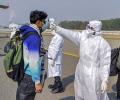
'Our government's claim that there are no undetected cases of infection that happened within our bustling cities because of exposure to infected international travellers are not credible,' notes Rahul Jacob.
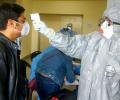
'In India, A3i is found mostly in southern India, and a few in Delhi. You don't see this strain much in, say, Gujarat or Maharashtra.'
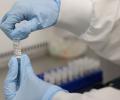
According to the World Health Organisation, 10 candidate vaccines for COVID-19 are in the clinical evaluation and 126 are in the pre-clinical stage.
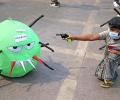
There can be no one answer to the question at the centre of an anxious debate across a world coping with COVID-19 and wondering what will happen if another one comes, but the global scientific community has been working on multiple tracks to ensure that humankind is better prepared.
Recent studies in China and Europe observed that the infection might relapse in those people who have already recovered from earlier phases.
'But to see the effects of that, it will take a week or two more.'

The govt said that states have been asked to classify districts which have reported a higher number of cases as hotspots, the districts where cases have been reported as non-hotspots, and green zones where no cases have been reported.

'One thing we have learnt is that a pandemic can be arrested at any stage.' 'Not suddenly, of course, but slowly with steady unwavering focus.'

'If you delay the diagnosis even by 24 hours, in that 24 hours individuals would have affected more people.' 'So, contact tracing, testing, isolation, quarantine needs to continue.'

The expert noted that in India the pandemic is unlikely to be over in the months to come, and the number of people getting infected will continue to rise.

'Essentially there are three things the government should be doing: Identify who you are going to get your vaccine from, figure out how you are going to pay for it, and figure out how you're going to deliver it and to whom.'
'At the stage where we are in today in the country, by the time mass vaccination becomes available, it would be around the middle of next year.' 'Most of those people, who got infected this year, will be next year back to level zero -- once again susceptible.'

This doctor couple put their faith in India. And in return India has put faith in them.

The vaccine candidate, ZyCoV-D, showed a "strong immune response" in animal studies, and the antibodies produced were able to completely neutralise the wild type virus, Zydus said. The 12 institutes have been asked by the ICMR to fast track clinical trials of the vaccine as it is being considered as one of the top priority projects which are being monitored at the topmost level of the government.

'We are hoping by March, the government allows us to export and give it to the private market.'
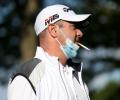
'Smokers are a highly susceptible population during this pandemic.' 'Health benefits from quitting smoking can start as early as within an hour.'

'All of our lives are going to be changed in a permanent way...' 'We just have to ride out the tide right now and we will see a rainbow at the end of this.'

'People who have already got diabetes or heart disease or high blood pressure seem to be more badly affected by the disease.'

'Unless some serious steps like complete closedown are taken, it will have disastrous consequences.'

'Between its natural immunity with Delta, in so many populations, and then getting on top of the vaccination (situation), I do not think India is going to have another bad wave.'

The masked, blue gowned and now fogged face shields were highly skilled and capable health care workers -- but inside their protective clothing they were people, with emotions -- sad, fearful, tears pouring down their masks and dripping off the sky blue water repellent gowns. Even Kevin the hulk, the male nurse who I saw lift a patient single-handedly to place an X-ray plate under the chest, was staring at his foot wear, moved to tears. Dr Sanjeeth Peter reveals what goes on in a Covid ICU: The second of a heart-wrenching multi-part diary of a Covid Warrior.

The lawsuit seeks an injunction to stop the entire rule from going into effect.
More than 2 million people have been diagnosed with coronavirus across the world, and the pharmaceutical industry is pulling out all stops to find potential treatments and vaccines for the global pandemic. According to the World Health Organization, there are now more than 70 potential vaccines under evelopment, with some already in clinical trials.

'65 per cent were males.' 'Age group of deaths: More were seen from age 51 to 70.' 'Saw some deaths from age 21 to the 40s.' 'About 76 to 77 per cent of patient deaths had some kind of a comorbidity.' 'The main comorbidities were the presence of diabetes, hypertension, some kind of heart diseases.'

'Vaccination is the only safe way to get immunity.'

'All the vaccines that are available in most countries, right now, are all highly effective and safe.'

'You will still want to take all the necessary precautions, which is the right thing to do.'

'If everybody with flu symptoms approach hospitals, it will create a very difficult situation for our health system.'

'Whenever you roll out: effectiveness is important, operational logistics are important, side effects are important and vaccine hesitancy is important.'

'The larger number of patients, who are being affected by COVID-19, are essentially people who have a history of heart disease to begin with, and then experience a more severe form of the infection with COVID-19, because of the existing risk factor.'

'Vigilance is the enemy of the virus.' 'We need to be alert all the time, about this, until we fully understand it.' 'And that's going to take years, actually.'

'We cannot be naughty and expect the government to do good!' 'We have to behave ourselves and then we can expect the government to support us.' 'If we are able to protect ourselves well, then we should not be having deaths.' 'Unfortunately, people have gotten into this super scary event participation (mode) -- birthday parties, large gatherings.' 'Among the people who have attended those, 80 to 90 per cent of them have come down with COVID-19.'

'There are different reasons for brain involvement depending on how the virus has entered the body.' 'If the virus enters the brain from the nose, the impairment will be different as opposed to if the virus impairs other organs which in turn impair the brain.' 'If it affects the lungs or heart, there can still be brain changes from secondary effects of reduction in oxygen delivery, or reduction in blood supply to the brain.'

'It is absolutely important for us to continue to message to people that they must wear masks, keep physical distancing, as much as is practically possible, at work or at home.'

'The only idea -- the only idea -- of the shutdown was to buy time.'

'Every disease has traits and we have found out that actually 99 per cent of people who have got COVID-19, should recover.'

'The majority of transmission will be via people who are within two metres of one another.' 'The closer you are, the more likely that you'll be infected.'

'The majority of the spread is by people coughing, or sneezing or talking loudly, in a very short distance, two metres from one another, and a mask will prevent that sort of transmission.'

'Prevention plus vaccination is what is going to take us into better territory by September or October.'

 © 2026 Rediff.com - Advertise with us - Disclaimer - Privacy Policy - Sitemap - Feedback - About us - Terms of use - Grievances